
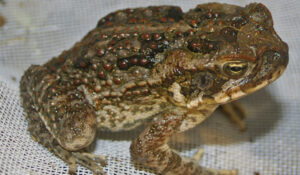
Picture credit: Wikipedia/Bidgee
Farmers can “cane toad-proof” their lands and help stop the invasive species from marching into the Pilbara, Curtin University researchers say.
Curtin University molecular scientist Judy Dunlops says making small changes to cattle water points can halt the spread of the large, poisonous toads without affecting farm work.
Humans first brought cane toads to Australia in the 1980s to control beetles on sugar cane farms.
However, the toads did not eat the beetles but instead began eating native species and spreading across the country.
Today, they are moving toward the Pilbara and experts say they could arrive within 10 to 20 years.
Farmers can help by using water tanks instead of open dams and making sure water troughs are at least 50cm tall because cane toads are not good at jumping or climbing.
The researchers say farmers can create a “toad containment zone” by creating smooth water troughs that are more than 52cm high to prevent the toads from using the water sources as “stepping stones” to travel through dry areas.
If the spread of cane toads does not stop, they could take over 75 per cent of the region within three decades.
Cane toads are a major threat because they are highly toxic.
Native predators that are used to eating frogs often eat the toads and die from the poison.
Murdoch University wildlife biologist Nicholas Wu said the Pilbara is a “biodiversity hotspot”, with many species found nowhere else.
“We’ll be losing a lot of biodiversity if the cane toads are able to reach into the Pilbara area,” Dr Wu says.
Many native animals are in danger of dying out.
The northern quoll and the floodplain goanna are the two species most badly affected.
Other animals at risk include the ghost bat, olive python, kaluta, and blue-tongue skink.
Some local snake populations are already declining in other areas because they die after eating the toads.
Curtin University researcher Ben Philips said toads do not have “sticky feet” like other frogs.
“They can’t jump very high at all,” Dr Phillips said. “They can’t escape sheer barriers that are higher than 52cm.” .
Fixing leaks and overflows is also a simple, low-cost way to stop the toads.
Stopping the toads also protects animals that are culturally important to Traditional Custodians for food and storytelling.
It also helps the mining sector by preventing more species from being added to the threatened species list, which can make mine approvals more difficult.